

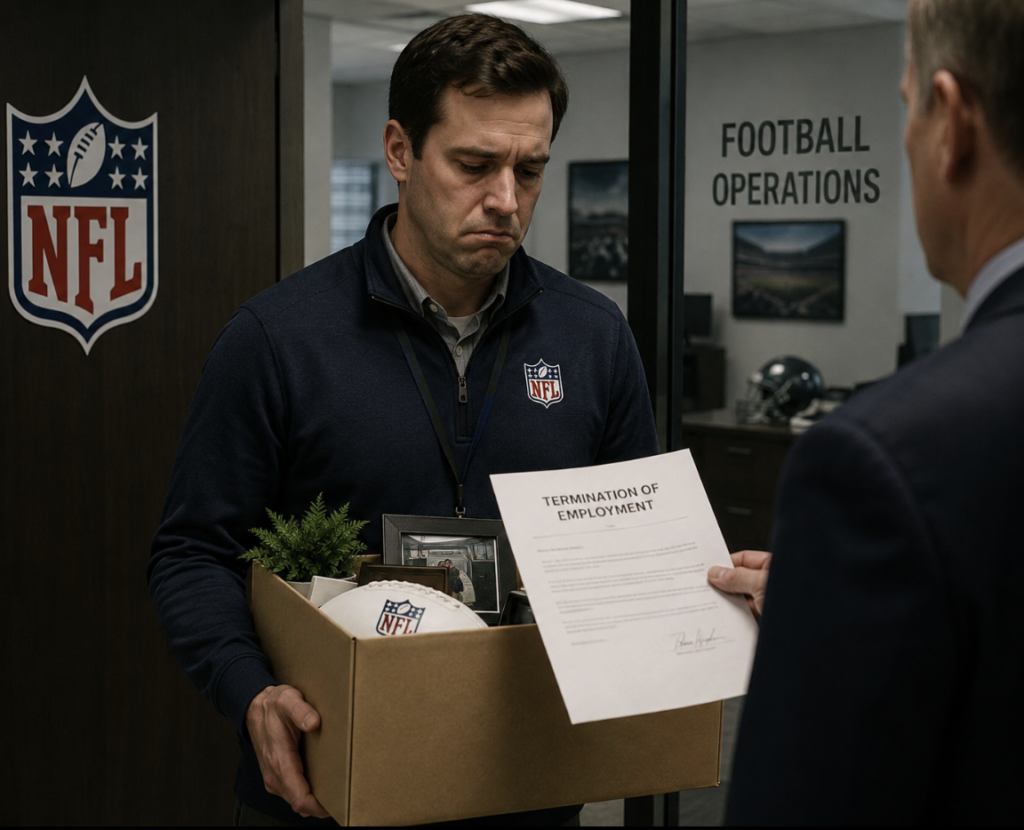
You're Under Investigation by the League and Your Job Is on the Line. Here's What to Do First.
At Giordano Law Offices we marshal our experience in high-level federal and state criminal investigations and employment law to help our professional sports clients through difficult situations. It is more often than not the case when the Commissioner or investigatory body of your league undertakes an investigation into a complaint made against you, your franchise/employer will come after you simultaneously. Even if you are highly valued or prized by your team, if there is any hint that you might become a liability or increase the team’s exposure to a league investigation, expect to get thrown under the bus.
If you’re a player, coach, director, manager or other employee in the NFL, MLB, the NBA, or the WNBA and you’ve just learned that you’re facing league investigation, a call from HR, or both, the next 48 hours matter more than almost anything that comes after. What you say to HR, your manager or a league investigator, can inadvertently shape a criminal case, in addition to job termination, a league suspension or other sanction, all at once.
Make no mistake about it: Before it is too late, you need to realize you don’t have just one problem. You have three. Your team may be building a case to terminate you or thinking about going in that direction independently or if they caught wind of a league complaint or inquiry. The league office may be responding to a complaint, investigating and/or building a separate disciplinary case against you. And if the underlying conduct is serious enough or also potentially criminal in nature, a referral to a prosecutorial agency, DA or US Attorney may be coming down the pike. It is telling that often former prosecutors work in league investigatory units.
These three processes can run on different clocks or simultaneously. There are different rules that apply to each, the employment aspect, league investigation and criminal inquiry, and different standards of proof apply to each. If you don’t have a lawyer who understands how all three interact, decisions that seem obviously right for one of them, cooperating fully with your employer, as would be required to keep your job, or responding to the league’s investigators, as is required by your collective bargaining agreement and league rules, or exercising your constitutional right to remain silent, you are at an extreme disadvantage.
The single most important thing: call a lawyer before you talk to anyone. You need to do this not after the team calls you in, not after the league sends a letter, but before.
Keep in mind that your employment contract likely requires you to cooperate with team investigations, and league policy almost certainly requires you to cooperate with a commissioner’s office inquiry. Generally, under employment common law rules, refusing to respond to an employer’s questions is grounds for dismissal. On the other hand, what you say to your employer could be used against you by the league and prosecutors. To say the least, you will be stuck between a rock and a hard place, confronting dire consequences in both directions.
Refusing to engage isn’t the goal, but how and when you engage, and what you say once you’re in the room, is something you should never navigate alone or on the fly. Every major league process gives you the right to have counsel or a union representative present for an interview. You should use it every time. This is not perceived as evidence of guilt. Rather, it is professionalism and an entirely appropriate response in such circumstances. This right has real teeth: the NFL’s own Personal Conduct Policy expressly states that players interviewed during an investigation may be accompanied by an NFLPA representative under Article 51 of the CBA. And, for example, MLB’s Joint Domestic Violence, Sexual Assault and Child Abuse Policy guarantees union counsel at formal player interviews. Outside of sports, the U.S. Supreme Court recognized this same basic principle for unionized employees generally in NLRB v. J. Weingarten, Inc., 420 U.S. 251 (1975), an employee has the right to request a representative at any interview the employee reasonably believes could lead to discipline. You should never waive or give up your Weingarten rights in these situations.
Criminal exposure comes first, even though you’re required to cooperate with everyone else or face termination and sanction. This is often the part that trips people up, and it’s the part where the wrong advice can do the most damage. Your team, manager or HR wants answers now. The league wants an answer and even your union representative may be pushing you to engage with the process so the union can “protect” you. The walls are closing in and all of that pressure is real, and none of it should ever come before this fact: anything you say to your team’s HR department, to a team investigator, or to a league disciplinary officer can end up in the hands of prosecutors and can be used against you in a criminal case. Keep in mind, hiding or destroying evidence, text messages or emails will land you in even more hot water and never a wise move. When you’re thinking about deleting text messages or similar cover your tracks conduct, it is time to call a lawyer.
Employment interviews and league interviews are not covered by the same protections as a conversation with your own lawyers who can speak on your behalf and provide you with the protection you need early on. There is no attorney-client privilege protecting what you tell your GM, your team’s outside counsel, or a league investigator. The team’s lawyer represents the team, not you — the same principle the Supreme Court laid out for corporate counsel generally in Upjohn Co. v. United States, 449 U.S. 383 (1981), where the privilege belongs to the organization, not to the individual employee being interviewed. If there is any realistic chance that the conduct at issue could also be charged as a crime, that risk must be assessed and managed before you say a single word to your employer or the league. Remember, once it’s said, it can’t be unsaid, and it may not stay confidential.
This doesn’t mean stonewalling everyone and hoping the criminal exposure disappears. It means the sequencing, timing, and content of what you say to your team and the league needs to be built around protecting you criminally first, with a lawyer managing that coordination, not you improvising it in real time under pressure.
On the flip side, “failure to cooperate” can be its own violation. You can’t simply follow the classic criminal defense playbook and stay silent and let the case run its course. This is what a criminal defense attorney, unfamiliar with very different employment laws, would suggest. This strategy will almost certainly result in immediate termination from your team and suspension, if not a lifetime expulsion from the league.
In several major league policies, refusing to cooperate with the league’s own investigation is typically treated as a separate, independent violation, sometimes punished more severely than whatever you were originally accused of. Declining an interview, refusing to produce records, or being anything less than forthcoming with the league isn’t a neutral “no comment.” It can become a second problem, on top of the first. Tom Brady learned this the hard way: in NFL Management Council v. NFL Players Association (Brady), 820 F.3d 527 (2d Cir. 2016), the Second Circuit reinstated Brady’s four-game suspension in significant part because the Commissioner treated his refusal to turn over electronic evidence during the “Deflategate” investigation as an independent basis for discipline, separate from the underlying ball-tampering allegation itself, and the court held Goodell was well within his broad contractual authority to do exactly that.
That’s exactly why this can’t be handled by criminal defense instinct alone, and it can’t be handled by an employment lawyer who doesn’t understand league discipline either. You need counsel who can look at the criminal exposure, the league policy’s cooperation requirements, and your team’s contractual rights all at once, and build one coordinated strategy, including, where appropriate, negotiating timing, scope, or protective terms around any interview, rather than either refusing outright or walking in unprepared.
At the same time, your job is exposed too, and often faster than people expect. While the league investigation unfolds, your team is not standing still. Whether your contract is fully guaranteed, only partially guaranteed, or an at-will coaching or executive agreement with a “cause” clause, the team’s ability to move on you depends entirely on the specific language in that contract, and on whether they act before or after the league reaches its own conclusion.
A team that terminates you before the league finishes its process is making its own judgment call about what happened and taking on real risk if that call turns out to be wrong. A team that waits for the league is, in effect, letting someone else make that determination for them. Which one your team chooses, and how you respond to it, is a major strategic decision, not something to react to in the moment without counsel. An attorney who knows how to navigate, and leverage both entities, your franchise and the league, against each other to your benefit, is your only hope.
Two more cases show why the details matter so much. In the Ray Rice arbitration, former federal judge Barbara S. Jones vacated Rice’s indefinite suspension in 2015, finding that the Commissioner had effectively punished Rice twice for the same conduct on the same known facts, after Rice had already served his original two-game suspension — a reminder that inconsistent or after-the-fact discipline is vulnerable to challenge. By contrast, in NFLPA v. NFL (Peterson), 831 F.3d 985 (8th Cir. 2016), the Eighth Circuit reinstated the arbitrator’s decision upholding Adrian Peterson’s suspension under a newly toughened personal conduct policy, holding that courts give enormous deference to a league arbitrator’s reading of the CBA even where the union argued the policy was applied unfairly or retroactively. The lesson from both: whether a league’s discipline holds up often turns on process and consistency, not just on the underlying facts, which is exactly the kind of fight that needs to be built into your strategy from day one, not raised as an afterthought on appeal.
Rules to follow that your team and the league don't want you to follow:
- Get a lawyer before your first interview with anyone. Not after the team schedules it. Before you’re even asked.
- Assume you have more than one matter, even if only your team has said something so far. League investigators most often want you to be the last person that knows you are being investigated or a complaint has been made against you. It could be an anonymous call to investigators or the Commissioner’s office. It could come from an adversary or someone who wants your job. In any event, you may be under investigation without having a clue.
- Do not sit for an HR interview, a team investigator’s questions, or a league interview without counsel who understands the employment consequences, the league’s disciplinary process and any criminal exposure. You are generally entitled to representation at these interviews, and you should use that right every time.
- Understand that refusing to cooperate isn’t a safe default. It can be its own violation. Your lawyer’s job is to manage how you engage, not to simply avoid engaging.
- Know your actual contract terms before you agree to anything, including any “cause” definition, guarantee language, and administrative leave provisions. These determine your real leverage, and you need a lawyer to review these terms before engaging or going on the record.
- Push for confidentiality wherever the process allows it. A resolved, confidential outcome is often worth more to your career than “winning” a public fight over the length of a suspension.
- Make sure your criminal lawyer and your employment/league counsel are the same team or are talking constantly. Facts developed in one proceeding show up in the others. Separate lawyers working in silos is how clients get hurt.
- The bottom line, if your employer or a league investigator wants to talk to you, that conversation is coming whether you’re ready for it or not, and the contract you signed and the policy you’re bound by both say you have to eventually engage. But when you engage, what you say, and how your criminal exposure is protected along the way is not something to figure out on a phone call with your GM or in a hallway before an interview.
- Get a lawyer who can see the whole board and knows how to make all the right moves on your behalf, navigating criminal exposure, league discipline, and your job before that first conversation happens, not after. If you’re a player, coach, or other franchise Director, VP, manager or other employee facing a team investigation, a league inquiry, or both, contact our office today. We represent clients across MLB, the NFL, the NBA, and the WNBA at the intersection of criminal defense, league discipline, and sports employment law.
Cases worth knowing
- NFL Management Council v. NFL Players Association (Brady), 820 F.3d 527 (2d Cir. 2016) — Commissioner’s broad authority to discipline for lack of cooperation, upheld.
- NFLPA v. NFL (Peterson), 831 F.3d 985 (8th Cir. 2016) — courts defer heavily to league arbitrators construing the CBA.
- In re Rice (NFL arbitration decision of Barbara S. Jones, 2015) — indefinite suspension vacated as an arbitrary, second punishment for the same conduct.
- NLRB v. J. Weingarten, Inc., 420 U.S. 251 (1975) — right to request representation at an investigatory interview that could lead to discipline.
- Upjohn Co. v. United States, 449 U.S. 383 (1981) — organization’s counsel represents the organization, not the individual employee being interviewed.
Key policy links
- NFL Personal Conduct Policy (NFLPA): https://nflpaweb.blob.core.windows.net/website/Departments/Salary-Cap-Agent-Admin/2022-NFL-Personal-Conduct-Policy.pdf
- NFL CBA, Article 46 (Commissioner Discipline) — available through the NFLPA’s public CBA resources at nflpa.com
- MLB/MLBPA Joint Domestic Violence, Sexual Assault and Child Abuse Policy — available through mlb.com/official-info and mlbpa.org
- NBA/NBPA Collective Bargaining Agreement — available through nbpa.com
- WNBA/WNBPA Collective Bargaining Agreement (2026) — available through wnbpa.com
This article is for general informational purposes and does not constitute legal advice. If you are facing a team or league investigation, contact our office directly. Please contact our firm today for a free legal consultation.